
Introduction: Is AI Replacing Humans—or Empowering Them?
A few years ago, the idea of machines writing articles, creating art, and analyzing complex data sounded like science fiction. Today, artificial intelligence tools generate images, automate customer support, and even assist doctors in diagnosing diseases. This rapid technological shift clearly highlights the growing AI Impact across industries and everyday life. Naturally, as AI becomes more powerful and widespread, many people begin to ask the same question:
Will AI take our jobs?
The fear surrounding the AI Impact on employment and businesses is understandable. Automation is transforming industries faster than any technological shift in history.
But here’s the reality most headlines miss:
AI is not replacing humans—it is reshaping how humans work.
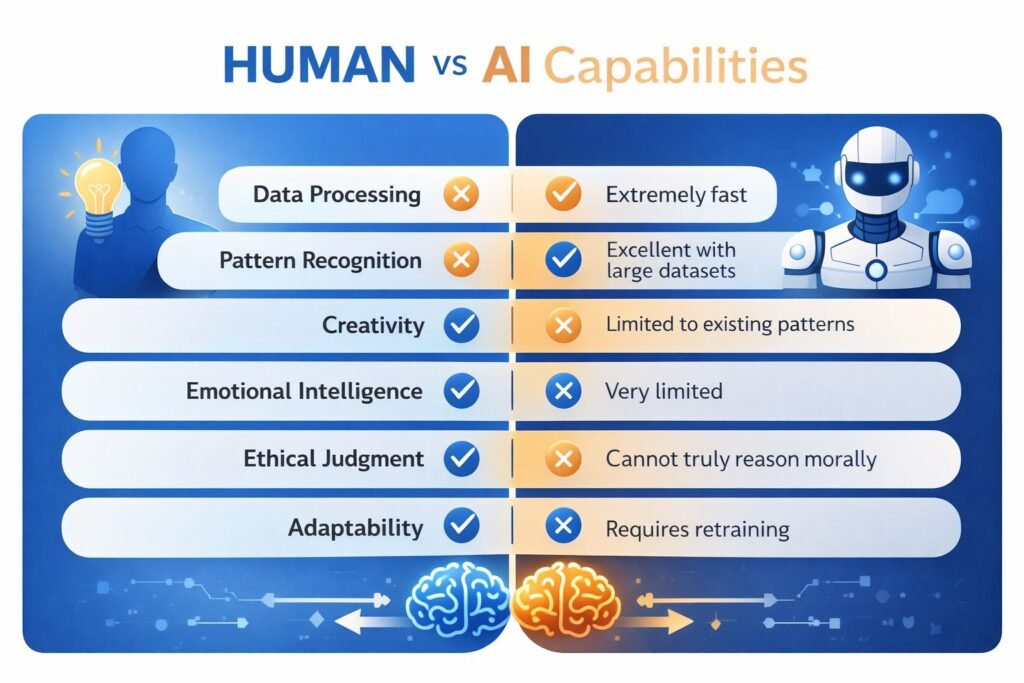
Instead of eliminating human value, AI is highlighting the importance of uniquely human abilities like creativity, empathy, ethical judgment, and strategic thinking.
In this article, we’ll explore the real AI Impact, compare human vs. AI strengths, and uncover why humans remain essential in the age of automation.
Understanding the Real AI Impact on Work and Society
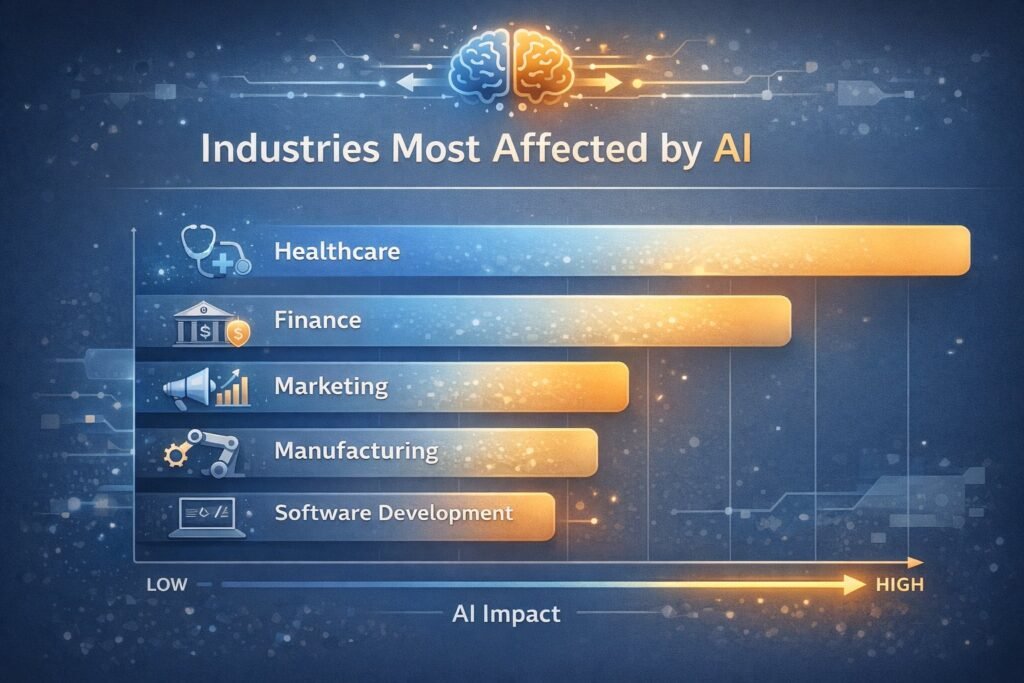
Artificial intelligence is transforming nearly every industry—from healthcare and finance to marketing and software development.
According to research from the World Economic Forum, automation may displace millions of jobs, but it is also expected to create new roles that require human-AI collaboration.
Similarly, studies from McKinsey & Company show that AI will automate tasks, not entire jobs. Most professions will evolve rather than disappear.
This distinction is critical.
AI excels at repetitive, data-heavy tasks, while humans remain superior at creative thinking, emotional intelligence, and ethical decision-making.
Let’s break down the comparison.
Humans vs AI: What Each Does Best
| Capability | Artificial Intelligence | Humans |
|---|---|---|
| Data Processing | Extremely fast | Limited |
| Pattern Recognition | Excellent with large datasets | Moderate |
| Creativity | Limited to existing patterns | Highly innovative |
| Emotional Intelligence | Very limited | Strong |
| Ethical Judgment | Cannot truly reason morally | Strong |
| Adaptability | Requires retraining | Highly flexible |
Key takeaway:
AI is a powerful tool, but humans provide direction, meaning, and context.
Automation handles tasks.
Humans create impact.
The Biggest AI Impact: Transformation, Not Replacement
One of the biggest misconceptions about AI is that it replaces entire professions. In reality, it automates specific tasks within jobs, allowing professionals to focus on higher-value work.
Let’s explore a few real-world examples.
1. AI Impact in Healthcare
AI can analyze medical scans faster than human doctors and detect patterns in large datasets.
However, doctors still play a critical role in:
- Diagnosing complex conditions
- Communicating with patients
- Making ethical treatment decisions
AI helps doctors work faster and more accurately, but it cannot replace human empathy and trust.
2. AI Impact in Software Development
Developers now use AI tools to:
- Generate code snippets
- Debug programs
- Automate documentation
But building software still requires:
- System architecture design
- Problem-solving
- Creative thinking
AI acts as a productivity partner, not a replacement.
3. AI Impact in Content Creation
AI can generate drafts, outlines, and summaries.
But human creators bring:
- Storytelling
- Perspective
- Authentic experience
Readers connect with human voices, not algorithms.
The Human Skills That AI Cannot Replace
While automation continues to advance, certain skills remain uniquely human.
These abilities will become more valuable in the future job market.
1. Creativity and Innovation
AI learns from existing data.
Humans create entirely new ideas.
The biggest technological breakthroughs—from the internet to smartphones—started as human imagination.
Innovation requires curiosity, risk-taking, and vision.
2. Emotional Intelligence
AI can analyze sentiment in text, but it cannot truly feel or understand emotions.
Human emotional intelligence enables:
- Leadership
- Team collaboration
- Negotiation
- Customer relationships
These skills are essential in business and society.
3. Ethical Decision-Making
AI cannot understand morality or cultural context.
For example, autonomous systems still rely on human judgment to determine:
- Safety standards
- Ethical guidelines
- Legal responsibilities
Organizations like OpenAI and Google DeepMind emphasize human oversight in AI systems for this reason.
4. Strategic Thinking
AI analyzes data.
Humans interpret meaning and make long-term strategic decisions.
For example:
AI might identify a trend in consumer behavior.
But humans decide how a company should respond to it.
The Future of Work: Human + AI Collaboration
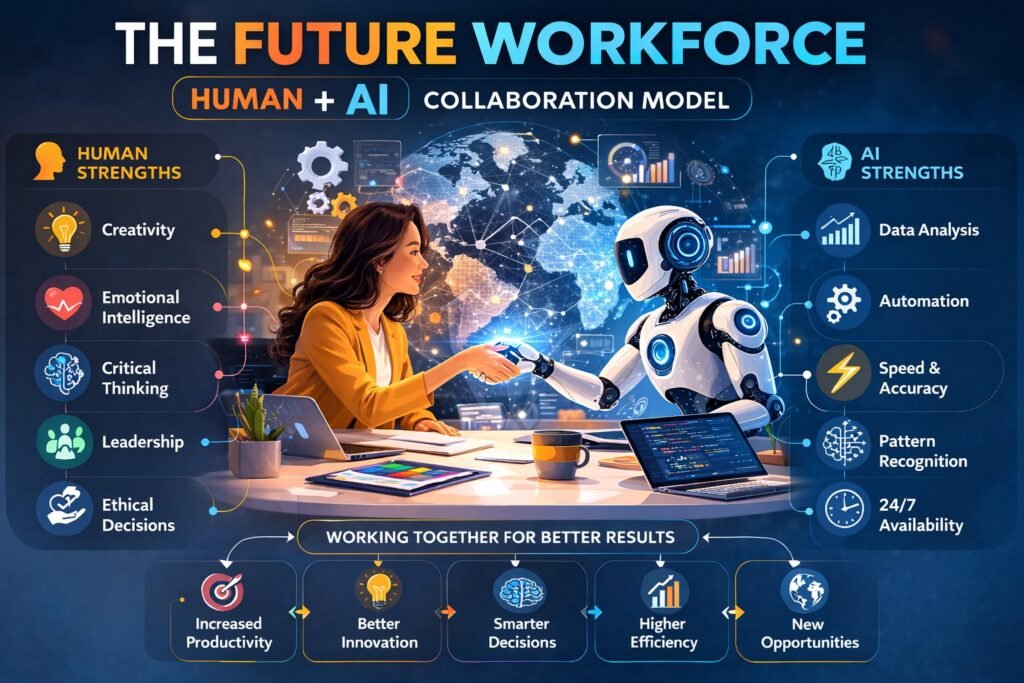
The most successful professionals in the next decade will not compete with AI.
They will work with AI.
This concept is often called “augmented intelligence.”
Instead of replacing humans, AI amplifies human capability.
Examples of Human-AI Collaboration
| Industry | AI Role | Human Role |
|---|---|---|
| Marketing | Data analysis & targeting | Creative campaigns |
| Healthcare | Medical data processing | Patient care |
| Finance | Risk analysis | Strategic investment |
| Education | Personalized learning tools | Mentorship |
The future workforce will require hybrid skills:
- Technical understanding of AI
- Human-centered skills like creativity and leadership
How Professionals Can Adapt to the AI Impact
Rather than fearing AI, professionals should focus on adapting their skill sets.
Here are practical strategies.
1. Learn AI Literacy
You don’t need to become a machine learning engineer.
But understanding how AI tools work will help you stay competitive.
Examples include:
- AI-powered writing tools
- Data analytics platforms
- Automation software
2. Focus on Human-Centered Skills
Skills that will remain valuable include:
- Critical thinking
- Creativity
- Communication
- Leadership
These abilities cannot easily be automated.
3. Use AI as a Productivity Tool
Professionals who leverage AI effectively can achieve massive productivity gains.
For example:
- Writers use AI for research assistance
- Developers use AI for debugging
- marketers use AI for data insights
Instead of replacing jobs, AI often multiplies human output.
The Psychological Side of AI Fear
Much of the fear around AI stems from uncertainty.
Historically, every major technological revolution triggered similar concerns.
For example:
- The Industrial Revolution introduced machines that replaced manual labor.
- The computer revolution automated office tasks.
- The internet transformed communication and commerce.
Yet each wave of innovation created new industries and opportunities.
The AI revolution is likely to follow the same pattern.
Key Insights About the Real AI Impact
Here are the most important takeaways.
- AI automates tasks, not entire professions
- Human creativity remains irreplaceable
- Emotional intelligence is uniquely human
- Ethical oversight is essential in AI systems
- The future belongs to human-AI collaboration
Rather than replacing humanity, AI may actually highlight what makes humans unique.
Conclusion: The Future Is Human + AI
The conversation around automation often focuses on what AI can do.
But the more important question is:
What can humans do that machines cannot?
The answer includes creativity, empathy, leadership, ethics, and vision.
These qualities will shape the future of work.
The real AI Impact is not about machines replacing people.
It’s about people becoming more powerful with intelligent tools.
In the coming decades, the most successful individuals and companies will not resist AI.
They will embrace it while strengthening the human qualities that machines cannot replicate.
Call to Action
AI is transforming the world faster than ever.
But what do you think about the real AI Impact?
- Do you believe AI will replace jobs?
- Or will it create new opportunities?
Share your thoughts in the comments below.
And if you enjoyed this article, explore more insights on AI, technology, and freelancing here on your blog at zrtashi.com.